

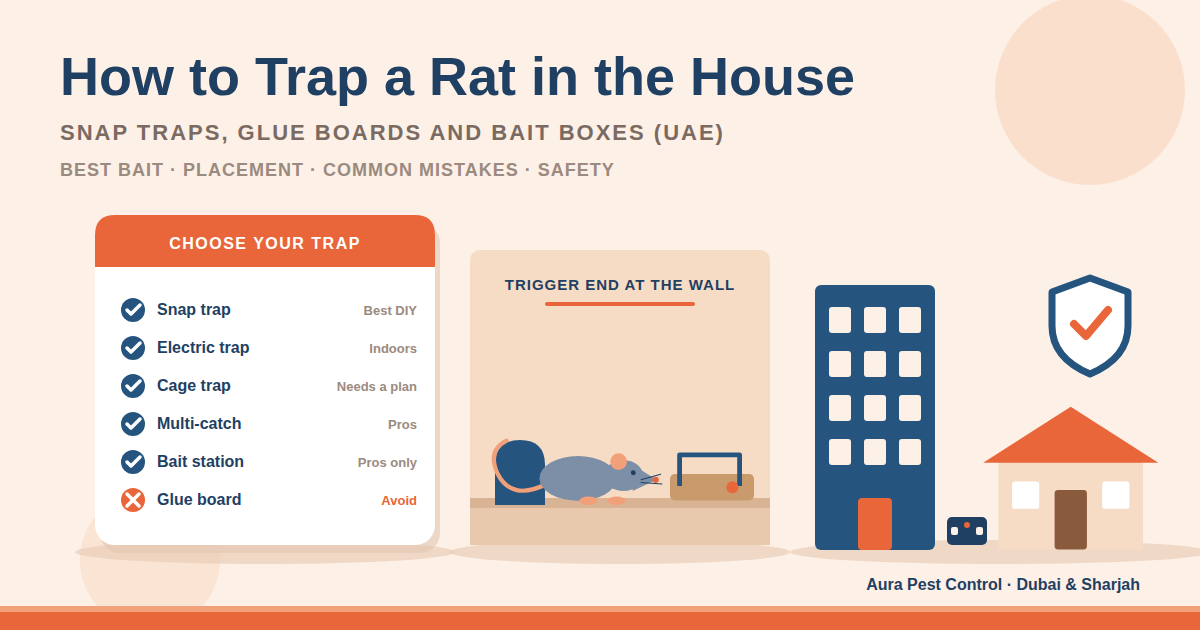
To trap a rat in the house, find its runway along a wall, place a baited snap or electric rat trap there with the trigger end against the wall, and leave unset baited traps out for two or three days first. Check traps daily, wear gloves, then seal the entry points. Avoid glue boards, and leave bait stations to professionals.
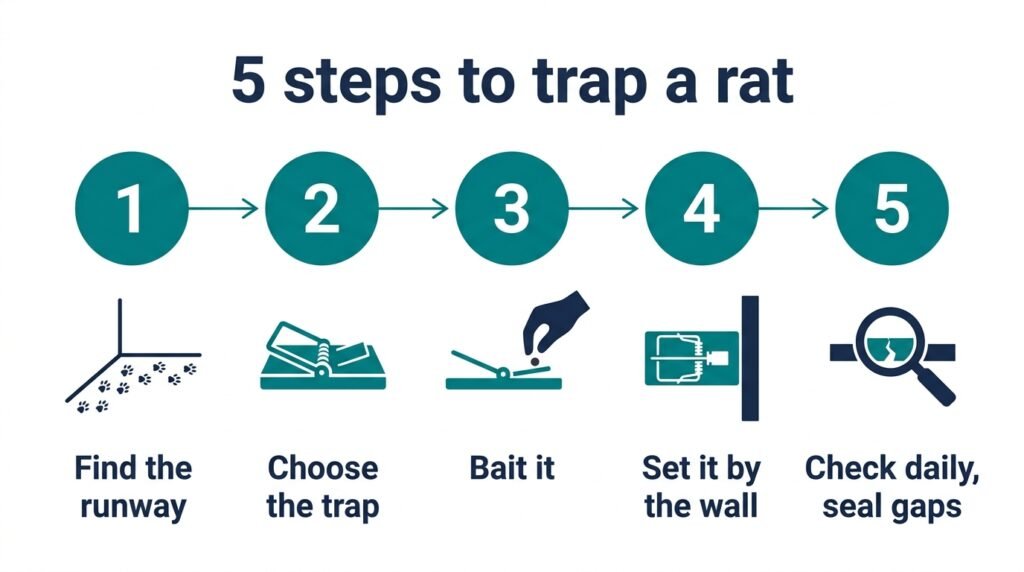
- Confirm it is a rat and find the runways: droppings, rub marks and gnaw marks along walls.
- Choose a rat-sized trap. A mouse trap is too small for a rat.
- Bait lightly and pre-bait. Put the trap out unset first, because rats are wary of new objects.
- Place several traps along the wall, behind appliances and near where you saw droppings.
- Check daily, dispose safely and seal gaps. Traps alone do not solve an infestation.
This guide covers every common way to trap rats: snap traps (including steel and metal rat traps), electric traps, cage traps and multi-catch traps, rat glue traps, and rat bait boxes (bait stations). For the full plan to clear a home, read our pillar guide on how to get rid of rats in the house.
1. Choose the trap: snap, electric, cage, multi-catch, glue board or bait station
The best rat trap depends on where you are using it, how many rats there are and whether children or pets live in the home.
| Option | How it works | Pros | Cons | Our verdict |
|---|---|---|---|---|
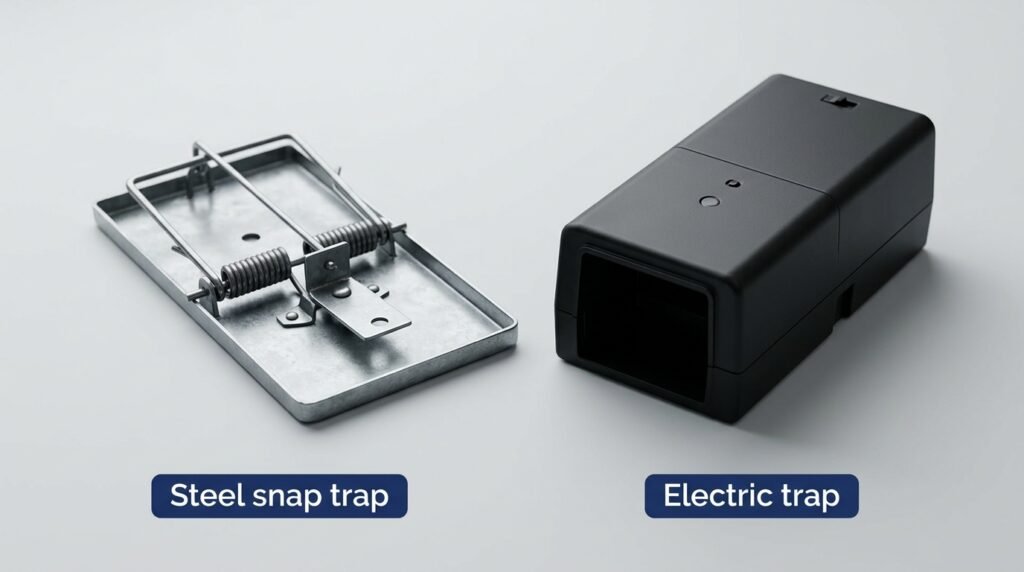
| Snap trap (steel or metal rat trap) | Spring bar kills the rat when it takes the bait | Cheap, quick, no poison, reusable if metal | Catches one rat at a time, needs daily checks, can injure fingers or pets | Best DIY option for small problems |
| Electric rat trap | Enclosed box that kills with an electric shock | Fast, tidy, closed so safer for children | Costs more, needs batteries | Good for kitchens and indoor areas |
| Cage trap (rat catcher cage) | Door closes when the rat enters | No kill, reusable | Stressful for the rat, awkward to handle, rats avoid cages | Only with a plan for the rat afterwards |
| Multi-catch trap | Catches several rats without resetting | Useful where many rats are active | Needs correct placement and regular checks | Mostly used by professionals |
| Glue board (rat glue trap) | Sticky surface holds the rat | Cheap | Cruel, unreliable, catches pets and wildlife | Not recommended |
| Bait station (rat bait box) | Locked box holding rodenticide | Controls a whole population | Poison risk, slow, secondary poisoning | Professional use only |
Rat trap or mouse trap? People often search for a “mouse rat trap”, but a mouse trap is too small and weak for a rat. It can injure a rat without killing it and make it wary of traps. Use a trap that is marked for rats.
2. How to trap a rat in the house: bait, placement and common mistakes
Best bait for a rat trap
The best bait for a rat trap is something sticky, strong-smelling and high in fat or sugar. Rats prefer these foods:
- Peanut butter, because it is sticky and rats have to work at it.
- Nuts and seeds, such as almonds or pistachios.
- Dried fruit, including dates and raisins, which are easy to find in the UAE.
- Bacon rind or a small piece of cooked meat, which is attractive when other food is not available.
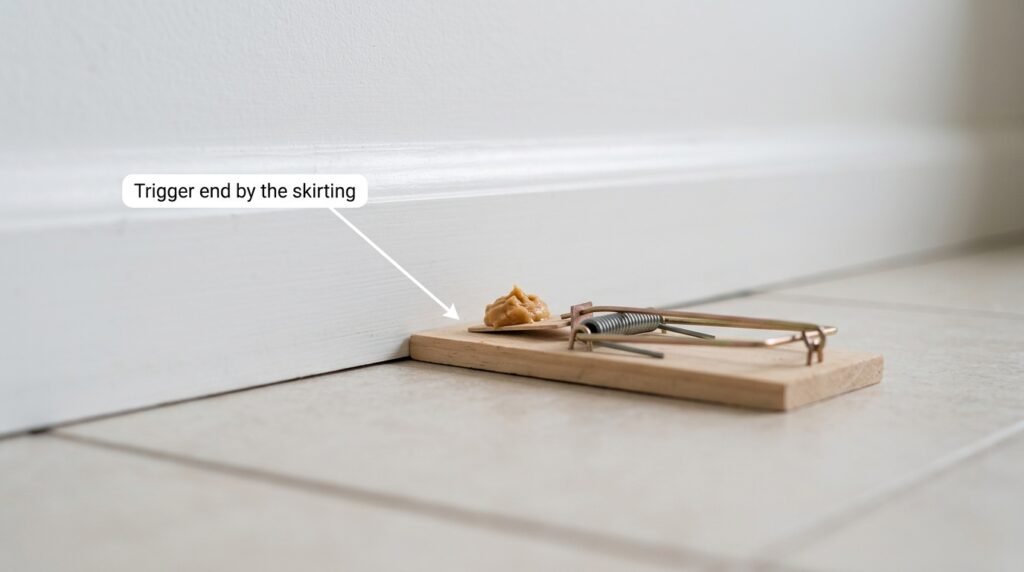
The old idea that rats love cheese is mostly a myth. Use a pea-sized amount pressed into the trigger, and tie dried fruit or nuts to the trigger with a thin thread so the rat cannot just lift it off. If you want the best food for a rat trap, pick the one that matches what the rats are already eating in your home.
Where to place rat traps
- Along walls. Rats run along edges. Place the trap at a right angle to the wall with the trigger end next to it.
- On the runways. Put traps where you see droppings, grease marks or gnawing.
- Behind and under appliances, inside cupboards and under sinks.
- Stores, garages and maid’s rooms, near boxes and stored items.
- Ceilings and false ceilings. Roof rats travel along beams, pipes and cable trays. Only place traps in a ceiling void if you can reach it safely, or ask a professional.
- Outside, in covered boxes close to the wall, away from pets and children.
Use more traps than you think you need. Several traps along each runway work better than one trap in the middle of the room.
Common mistakes
- Setting the trap straight away. Rats are trap-shy. Put it out baited but unset for two or three days, then set it.
- Too much bait, so the rat eats it without triggering the trap.
- Handling with bare hands, which leaves a human scent.
- The wrong trap size (a mouse trap) or traps placed in the open instead of against a wall.
- Not enough traps, or moving them every day.
- Leaving food out that competes with the bait.
- Not checking daily, so a dead rat stays in the trap and creates smell and hygiene problems.
3. Rat bait boxes and bait stations: how they work and where to place them
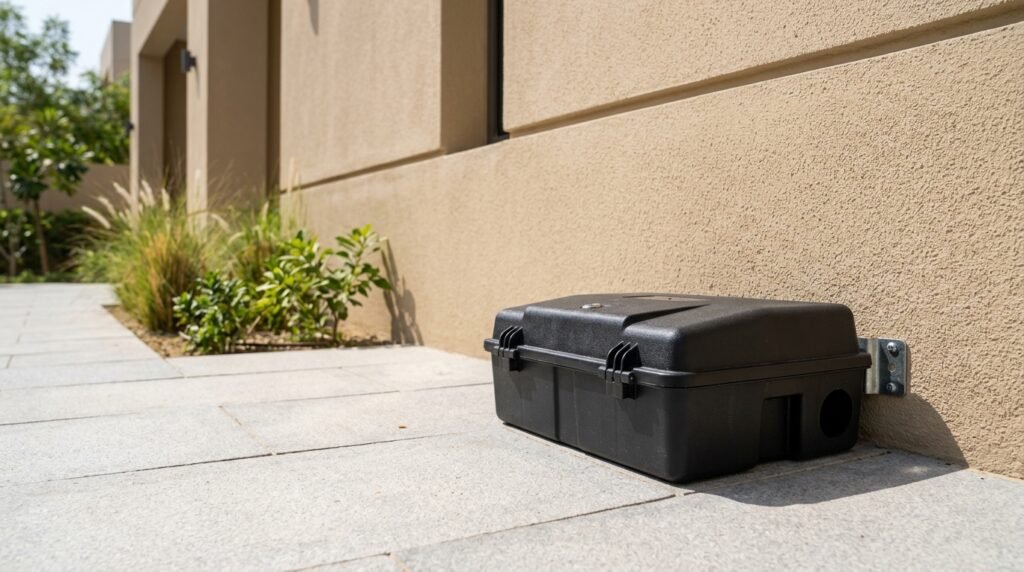
Many people search for a “rat box”, “black box for rats”, “rat poison box”, “rat killer box”, “rodent control boxes” or “rat trap box”. In most cases they mean a rat bait station. This is a closed plastic box with openings for rats to enter, and with a lock or a tool-operated lid to protect the bait inside. Some shops also sell enclosed “rat catching boxes”, which are traps and not bait stations.
Bait station vs trap box vs snap trap
| Bait station | Trap box (enclosed trap) | Open snap trap | |
|---|---|---|---|
| What it holds | Rodenticide bait | A trap mechanism, with no poison | A spring trap and bait |
| How rats die | Slowly, over several days, often out of sight | Quickly, inside the box | Quickly, in the open |
| Risk to pets and children | Low if tamper-resistant and placed correctly, but poison is involved | Lower, because the mechanism is enclosed | Higher, if not covered |
| Best for | Larger infestations, villas, warehouses, restaurants | Kitchens and indoor areas | Small problems |
How tamper-resistant stations protect children and pets
A tamper-resistant bait station is locked, so the bait cannot be taken out, and rats can only reach it through small side openings. The bait is fixed inside so it cannot be shaken out. A properly secured station is much safer than loose bait or a homemade box, but poison is still involved, so the station must be anchored and placed out of reach.
Placement rules
- Place stations along walls and on runways, where rats already travel.
- Outdoors, put them close to the building wall, near burrows, bins, garden storage and fruit trees.
- Indoors, use stores, garages and roof voids, and keep them away from food preparation areas and places children can reach.
- Anchor stations so they cannot be moved, and check them regularly.
Poison risks and secondary poisoning
Rodenticide works slowly, so rats may leave the station and die in walls, ceilings or gardens. A pet, bird or other animal that eats a poisoned rat can also be poisoned, which is called secondary poisoning. If you suspect a pet has eaten bait or a poisoned rodent, contact a vet immediately. Never use fumigation tablets or unlabelled chemicals indoors.
Why professional placement works better
A technician identifies the species, finds the runways, chooses the right product, places enough stations in the right positions, keeps records and removes them when the job is done. DIY use often fails because stations are placed in the wrong spot, are not checked, or are left in place with old bait.
For a pest control approach for houses and residential areas, see our rodent control service.
4. Rat glue traps: do they work, are they safe, and what to use instead
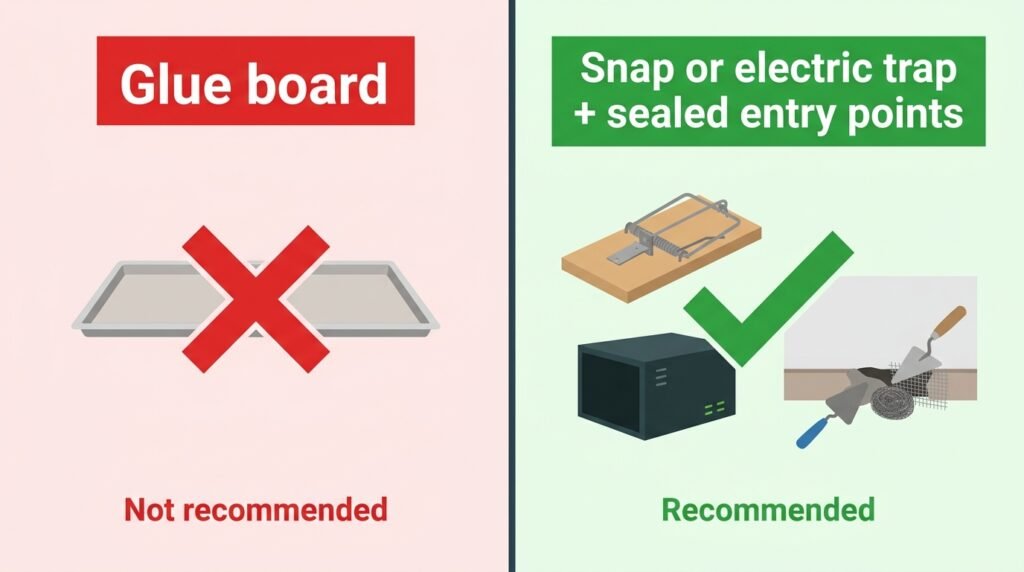
The honest verdict: rat glue traps (also sold as mouse and rat glue boards) are not recommended. They can catch a rat, but they are cruel, unreliable on adult rats, and unsafe around pets, birds and lizards.
How glue traps work
A glue trap is a board covered in a very sticky adhesive. When a rat steps on it, the glue holds its feet and body. The rat is not killed: it struggles and may stay stuck for hours or days.
Pros, cons and safety
- Pros: cheap and easy to buy.
- Welfare: a trapped rat suffers, and animal welfare groups and many professionals oppose glue traps for this reason.
- Reliability: large, strong rats can pull free, leaving a rat that now avoids traps, and the glue can fail in dust and heat.
- Safety: pets, children, birds and lizards can be caught by accident, and the rat can bite when someone approaches.
- Mess and hygiene: boards are hard to dispose of, and an infested board can be messy and smelly.
Rules about glue traps differ by country, and some places have restricted or banned them. If you are not sure, ask your building management or the local authority.
If you still use one
Place it flat against a wall on a runway, out of reach of pets and children, inside a covered box if possible, and check it several times a day. Wear thick gloves. If a rat is caught, do not leave it to suffer. Call a licensed pest control company or a vet for help, or end its suffering quickly and humanely. Do not release a rat that is still stuck to a board.
Why traps alone do not solve an infestation
Even a perfect trap removes only some of the rats. If the entry points, food and shelter remain, more rats arrive. Glue boards also teach surviving rats to avoid new objects.
Better alternatives
- Snap or electric traps for a small number of rats.
- Tamper-resistant bait stations placed by a professional for larger problems.
- Sealing entry points and removing food and nesting sites. See rat proofing your home.
5. Why homemade rat traps fail
Searches for a “homemade rat trap” or “how to make a rat trap” are common, but homemade traps usually fail for these reasons:
- They do not kill quickly. A rat that is hurt or frightened becomes trap-shy and harder to catch.
- They are unreliable. Rats climb, jump and squeeze, so improvised containers often let them escape.
- They are unhygienic and unsafe. You may have to handle a live, frightened rat, which can bite.
- They only catch a few rats and ignore the real cause: entry points and food.
A proper steel snap trap, an electric trap, or professional help is cheaper in the long run.
6. Safety: gloves, disposal and droppings cleanup
- Is it safe to touch a dead rat? No, not with bare hands. Rats carry germs, and fleas and mites can leave a dead rat. Wear thick gloves and, if possible, a mask.
- Disposal. Put the rat, and the trap if it is disposable, in a bag, then double-bag it, seal it and put it in an outside bin. Wash your hands with soap and water afterwards.
- Droppings and urine. Do not sweep or vacuum dry droppings, because that spreads dust. Wet the area with disinfectant, wipe it up with disposable towels, bag them, and disinfect the surface.
- Food. Throw away any food the rat touched and disinfect worktops.
- Children and pets. Keep traps and bait out of reach. See our guide to pet-friendly and child-safe pest control.
7. After the catch: sealing entry points
When the traps stop catching rats, the work is not finished. Walk around inside and outside and seal gaps around pipes, AC lines, cable entries, vents, door bottoms and roof edges with metal mesh, steel wool plus sealant, or cement. Remove food, fix leaks, and clear clutter. If traps keep catching new rats, there is an open entry point or a source nearby, such as a bin room, garden or neighbouring unit. See our guide to the signs of rats in your house and our list of natural rat repellents and what they really do.
8. When to call a professional (and what we do)
Call a professional for rat control in Dubai or Sharjah if you see rats in the daytime, hear scratching in ceilings, keep catching rats or cannot find the entry points, or if you are in a restaurant, store or shared building.
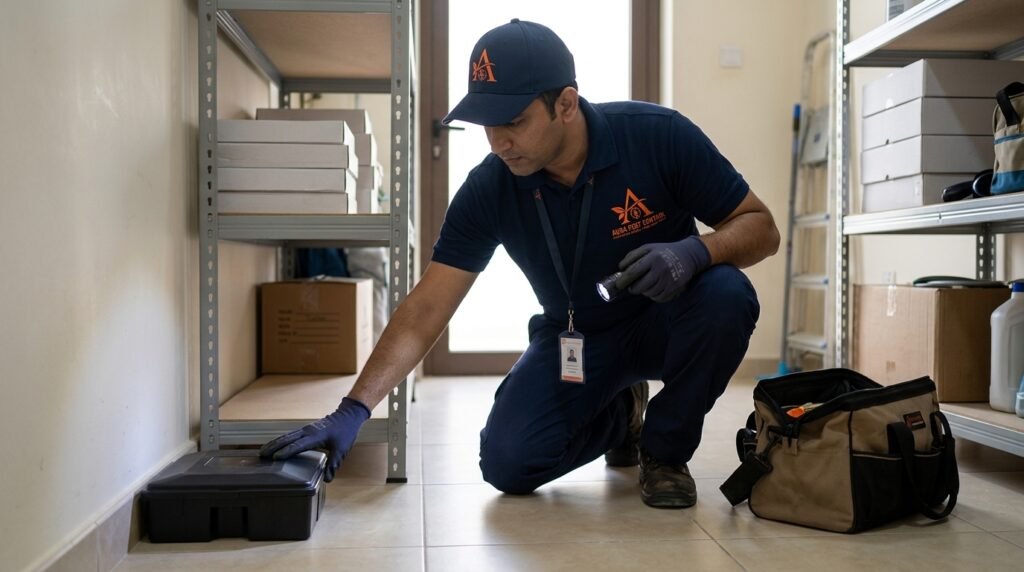
- Site survey and inspection to find runways, entry points and the species.
- A trapping and bait station plan using tamper-resistant stations where suitable.
- Targeted placement and monitoring, not scattered traps.
- Proofing advice so rats cannot return.
- Follow-up checks after 3 days and again after 2 weeks, with a 3-month warranty on our treatments.
For prices and what is included, see rat control cost in the UAE. We serve homes and businesses across Dubai and Sharjah.
9. Frequently asked questions
What is the best bait for a rat trap?
Peanut butter is the most reliable, followed by nuts, dates and other dried fruit, or a small piece of bacon rind. Use a pea-sized amount and press it into the trigger so the rat has to work to get it.
How long does it take to catch a rat?
Sometimes the first night, but often several days. Rats are wary of new objects, so pre-baiting and patience help. If nothing is caught after a week, change the position, not just the bait.
Why is the rat ignoring my trap?
It may be trap-shy, the trap may be in the wrong place, there may be too much bait, or other food may be easier to reach. Move the trap to a wall runway, use less bait, remove other food and put out unset baited traps first.
Is it safe to touch a dead rat?
Not with bare hands. Wear gloves, double-bag the rat, put it in an outside bin and wash your hands.
Do glue traps work on rats?
They can catch smaller rats, but they are unreliable on large adult rats, and they are cruel and unsafe around pets. We do not recommend them.
Are glue traps legal and humane?
Rules differ by country and some places restrict or ban them. They are widely considered inhumane, because the animal can suffer for a long time. If you are unsure, ask your local authority or building management.
What do I do with a rat caught on a glue trap?
Do not leave it. Wear thick gloves and call a licensed pest control company or a vet for help, or end its suffering quickly and humanely. Do not release it while it is still stuck to the board.
Are glue traps safe around pets?
No. Pets can step on the board, and cats and dogs may be injured or panic trying to free themselves. Birds and lizards are also caught.
Where should rat bait boxes go?
Along walls and runways, close to the building, outdoors near burrows, bins and garden storage, and indoors in stores, garages and roof voids. Keep them away from food areas and out of reach of children and pets, and anchor them in place.
Are bait stations safe for pets?
Tamper-resistant stations reduce the risk, but they are not risk-free. Pets can still be poisoned by eating a poisoned rat, so keep pets away from stations and call a vet at once if you suspect poisoning.
How long do bait stations take to work?
Rats usually take several days to die after feeding, and bringing a whole population under control can take a few weeks. The stations must be checked and refilled during that time.
Can I buy a rat box or rat trap in the UAE?
Traps and empty boxes are sold in some shops and online. Rules and product availability for rodenticides can vary, and a wrong product or placement can be dangerous. For poison baits we recommend using a licensed pest control company. If you search for “rat traps near me”, a shop sells you a trap, while a pest control service finds the cause and solves the problem.
Book rat control in Dubai or Sharjah
Caught one rat but the signs continue? Send us a photo and your area, and we will arrange a free inspection.
- WhatsApp: +971 52 408 0230
- Call: +971 52 408 0230
- Email: info@aurapestcontrol.ae
- Rodent control | Pest control in Dubai | Contact us